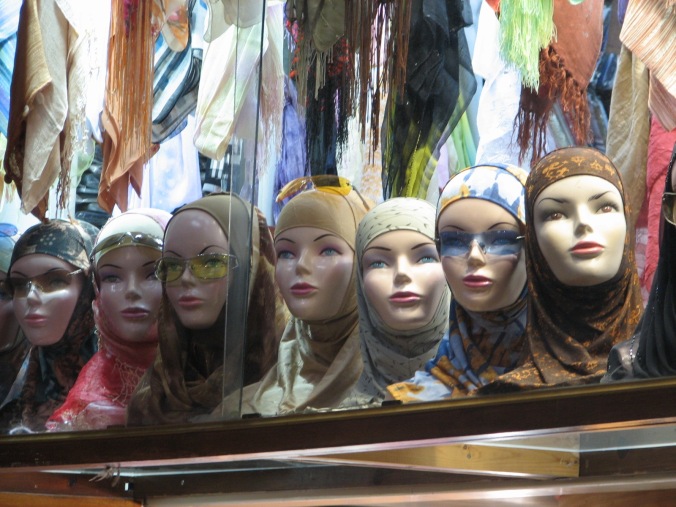
In November 2005, I traveled to Syria to do some research on the region and characters I wanted to write about in The Peddler. In particular, I visited Wadi Nasara, the Valley of the Christians, in western Syria. I also visited other Christian enclaves, including the Christian Quarter of old Damascus and the Christian towns of Malula and Saidnaya. My hosts, the al-Durrah family, were very helpful and gracious and assisted me in any way they could in my research.
It was not my first time in Syria. I traveled there in 1993, during the time the US and Norway negotiated the Oslo Accords between Israel and the Palestinians. In 1993, Syria was bizarre. I had never visited a totalitarian state before. It was like stepping into the novel 1984. I was interrogated while traveling on a bus from Homs to Palmyra after I asked some questions about the peace negotiations with Israel. I literally had some Syrians tell me to stop asking them questions, because I was endangering their lives.
In 2005, the contrast to 1993 could not have been more stark. I traveled freely throughout the country with my cameras, meeting people who talked with me openly about life in Syria. I did notice, however, that no one wanted to discuss history. Their memory did not seem to go back further than 40 years, when Hafez al-Assad first took power. The Syrians did express a deep desire for economic freedom and for justice. The economy was opening up and the cities and towns I visited were all very lively with commerce. Every one had satellite television and they watched programs from throughout the world. In fact, one of the most popular shows was Judge Judy. The notion that a legal complaint could be handled so swiftly greatly intrigued the Syrians, who cannot rely on their courts for swift and just resolutions. But that is a different topic for a different time.
Without further adieu, I am reproducing here the journal I kept in my few weeks in Syria in November 2005, where I uncovered the mysteries of the people and places I write about in The Peddler.
November 6, 2005
The excursion begins. I am staying with Michele (Abu Ziad) and Selwa (Um Ziad) al-Durrah and their family in their house in a suburb of Damascus, Dahat al-Assad. They have embraced me like a son and a brother; and fed me like a stuffed goose. I arrived at 1:30 a.m. and we stayed up until 4 a.m. talking and eating. Abu Ziad’s youngest son, Basim, and youngest daughter, Raghda, live at home. Ziad, the oldest, is married to a dermatologist, Hayam, and they have two kids. They live in Bab Tuma, the Christian quarter in Damascus. It is customary for children to live with their parents until they are married. Raghda, 32, has not married yet, despite the fact that she has had several proposals. She is a civil engineer (muhandissat) working for the city of Damascus. She is very shy, and she blushed and looked away the first time that I said “hello” to her. I feel bad that they gave me Basim’s room, which has two single beds in it. I am sleeping there alone, while Basim and Raghda share the next room.
Basim, 24, is in his third year of college, studying iqtisad, economics. He has a beautiful girlfriend, Katya, who is half Russian and half Syrian.
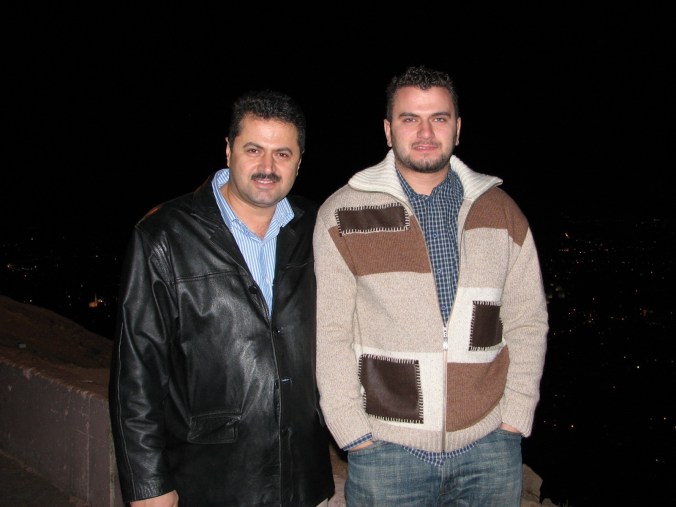
With Ziad and Basim at Jebel Qasyoun overlooking Damascus.
We stayed in all day on Saturday. We woke up around noon. Before I knew it it was 6 o’clock and we were eating dinner. Then, after dinner, we relaxed for a while. Then, Basim and Ziad and I went to Jebel Qasyoun and Bab Tuma. At Bab Tuma we went to a coffee house, qahweh, owned by one of Ziad’s friends. It’s called Beit Yasmine. His friend owns three cafes now and, according to Ziad, he is rich because of it. He is from a village in Wadi Nasara. He appeared distinctly disinterested in me when Ziad told him that I was an American and that I was writing a story about the Syrians who left for America in 1900 and returned to Syria in 1920. Then, he told him that I was a business attorney also, which got the response: “Muhami shaqat tayib.” The legal business is good!
It was very lively and engaging café and the décor was amazing. We each had a hubbly-bubbly, narghile, and some snacks. The snacking was one of the largest meals I have eaten in a long time. We left around 12:30 a.m. after about 3 hours.
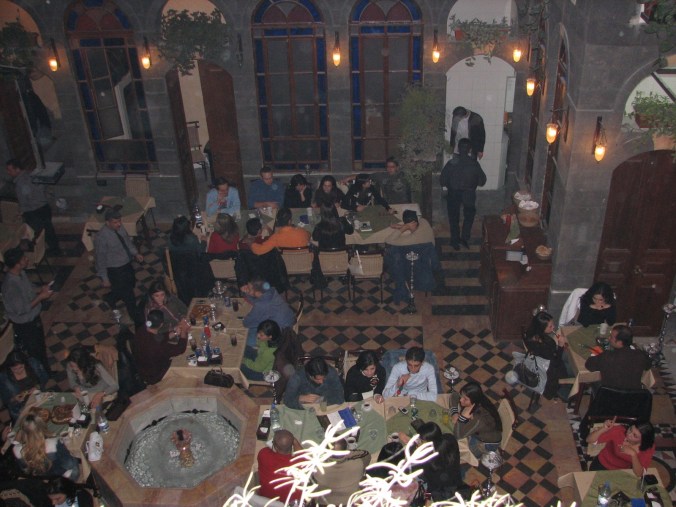
Qahweh Beit Yasmine
Fortunately, I am not sick at all. My stomach has adjusted fine. Even the tap water is safe – I haven’t gotten sick from brushing my teeth – although we drink bottled water from Kayme. The food is outrageously fantastic. The hospitality unlike anything you will find any where.
***
I had a very uncomfortable experience when we were driving from Jebel Qasyoun to Bab Tuma. I was video taping the drive and I saw a billboard of Hafez al-Asad. I turned my camera to video tape it and it was on a military building and the guard standing in front of the building made a very unhappy motion toward me and my camera. All I wanted was a picture of Hafez on the billboard. I had flashbacks of 1993. But, to my surprise, Ziad blew off the police man. He waived him away with his hand and the police me relented. Still, I put the camera down. I don’t want to cause trouble for Ziad and his family. I was very nervous for a few minutes after that and I will take extra precaution with it.
I have gotten a lot of stares, but I am not sure if it is because I look American, foreign, or like a jihadi with my beard. I think I throw every one off a bit. When I arrived, the mudheer at the airport asked where I was from originally and made a motion with his hand circling his face. I told him that my family was from Syria. He said “Welcome to Syria.” Then he asked where I was staying and I told him I was staying with family in Damascus, but I did not know the address. Then he suggested “the Sheraton” and I said, yes.
Although Damascus needs some city planning and construction, it looks and feels modern. Everyone has their own cell phone and every house has satellite television. There are as many new cars as there are old ones. A lot of construction is taking place and new office buildings and neighborhoods are being built throughout the city.
We watched Al-Jazeera, CNN, Egyptian, European and Syrian TV today. My Arabic is getting better by the minute. Many people, perhaps half or more, and all the Christians, dress very modern in styles that one would find in San Francisco or New York. Raghda dresses like a Suicide Girl, although I haven’t noticed any tattoos yet. Today when I met her for the first time she was wearing a pair of skin tight horse-riding-like pants and a zip up vest. Both in milk chocolate brown. And a pair of black, zip-up, ankle-high rocker boots. She would fit in at any modern city in the world.
Not only do they have Internet access from home, although it’s dial-up, Ziad had my lap top hooked up to the Internet in about 10 minutes. I didn’t work too well, so I used the PC in Basim’s room. Then, Basim connected me to his media phone and I made my first ever VOIP call. Again, because of the dial-up service, we could barely talk with the delay and cutting out of our voices. But still. Clearly, Syria has kept up.
The price of cars, homes and clothes are very expensive. The 3-bedroom apartment that Michele and his family live in cost them around $90,000 when they bought it several years ago. Ziad’s apartment cost him $150,000 about 5 years ago. Some apartments here go for $1 million. $200,000 to $400,000 is common. These are San Francisco figures. Cars that would cost $20,000 in the U.S. cost $30,000 here. Michele, Selwa, Basim and Raghda share the same car and hire a driver, Safi. He cost 8,000 SYR per month. Clothes are expensive too. I think most of the clothes are blackmarket, because until recently imports of clothing were banned. But a law just passed permitting all clothing imports, with a 40% tariff. So, they should remain expensive although plentiful.
There is a strong wind (shawal) this time of year bringing cold air from the North. It’s not very cold yet, but the wind last morning was severe.
Ziad does very well. He is a mechanical engineer and he now does the purchasing for his company, which does a lot of oil and gas pipeline work. He is looking for good business opportunities and is interested in my assistance. He mentioned the same lawyer that Chuck mentioned to me – Jacques Hakim. He is going to set up a meeting for me. One of Ziad’s ideas is to make cinnamon from Syria, which is not made here. He also wants to start serving as an agent and wants me to bring some American companies here for public contracting. We are going to review the public tenders published on line and draft an agency contract.
They are all very distressed about the threats from U.S. President Bush. They fear an attack by the U.S., which would be totally unwarranted.
At the same time, this is an opportunity for every one. For Assad to take control of his government. For Americans to learn the truth about the limits of American foreign policy in the Middle East. It is also an opportunity for the Syrian people to advertise how good they really are to the world — to come out of their shell, so to speak. It’s an opportunity for me to participate in this process, insha’ allah, by publishing my novel. And, it is an opportunity to wipe the slate clean, end sanctions and open up Syria the way that the people here want. They want political stability, elections, freedom, and trade. They do not want a war with Lebanon, Israel or the U.S.
 The Peddler
A hat tip to Stephen L. Moses for his important work on this topic. It is reminiscent of the seminal reporting, analysis, and commentary of George Antonius’s work in the Arab Awakening from a century ago. Every 100 years we are reminded how good research and writing sheds light on the problems of today much as Moses has done here. I look forward to following the Peddler, going forward, and suspect academics concerned with inculcating students with what has shaped the region based on first hand reporting, will do the same.
S. Mishra
Washington, DC
LikeLike